
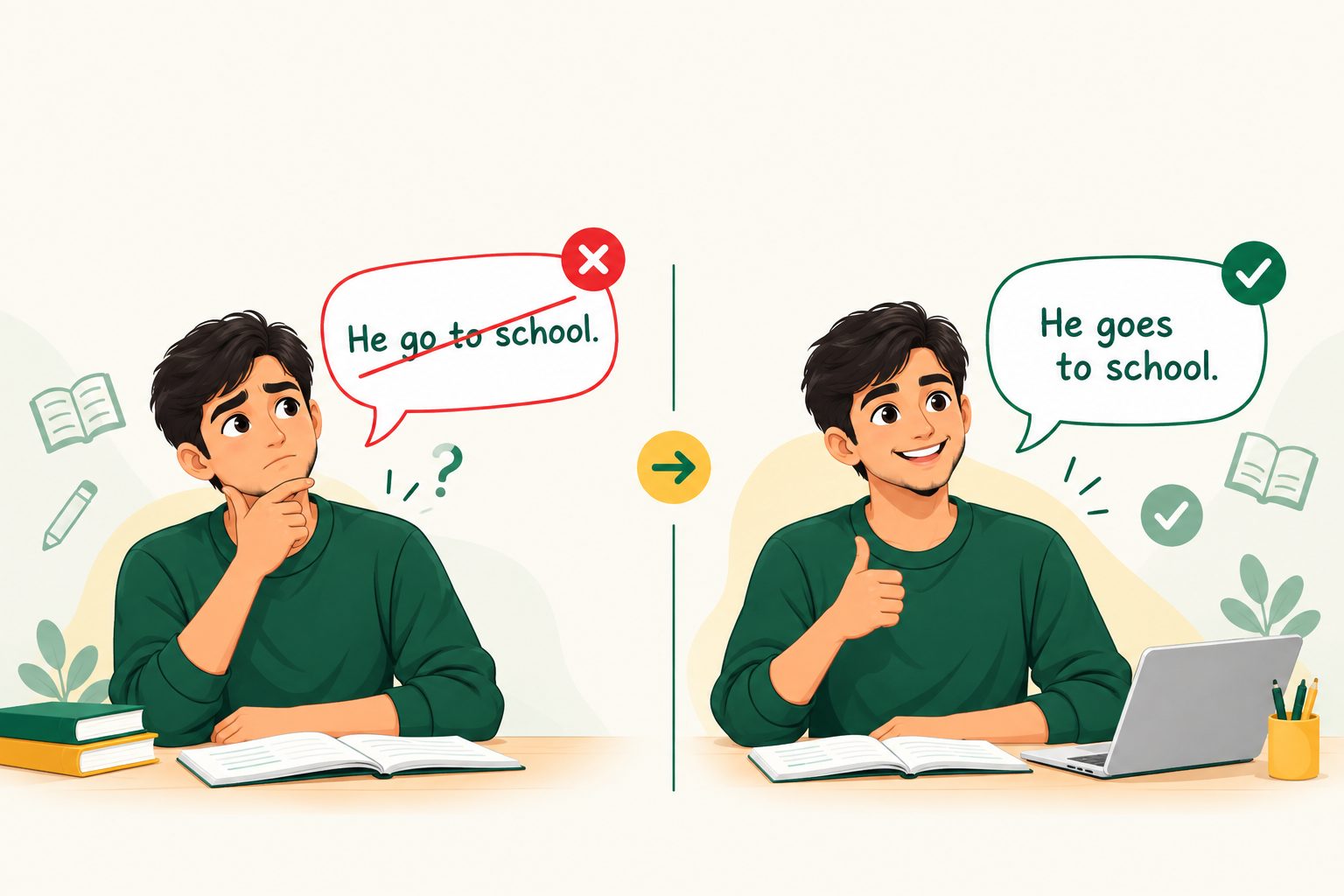
You may understand English but still hesitate when speaking in interviews, meetings, or everyday conversations. Sometimes this happens because you translate a sentence directly from Bengali, or apply a familiar grammar pattern to English. These examples are useful practice points—not mistakes made by every Bengali speaker. Notice the pattern, then practise saying the corrected sentence aloud.
1. Leaving out “a” or “the”
Incorrect: “I bought book yesterday.”
Better: “I bought a book yesterday.”
English often uses articles before singular countable nouns. The right article depends on whether the listener knows which item you mean.
2. Using the wrong verb form after “did”
Incorrect: “I didn’t went to class.”
Correct: “I didn’t go to class.”
After “did” or “didn’t,” use the base form of the verb: go, eat, see, finish.
3. Forgetting -s with he, she, or it
Incorrect: “She work in Kolkata.”
Correct: “She works in Kolkata.”
In the simple present, add -s or -es to most verbs with he, she, or it.
4. Using “am” before a normal verb
Incorrect: “I am agree with you.”
Correct: “I agree with you.”
“Agree” is already a verb, so it does not need “am.” Say “I am happy,” but “I agree.”
5. Using the continuous form for a state
Often better: “I am knowing him.” → “I know him.”
Correct: “I know him.”
Verbs such as know, understand, believe, and own are usually not used in the continuous form when describing a state.
6. Adding “about” after “discuss”
Less standard: “We discussed about the plan.”
Correct: “We discussed the plan.”
Use “discuss something.” You can say “talk about something,” but “discuss about something” is usually unnecessary.
7. Using “myself” as a self-introduction
Awkward: “Myself Rina.”
Natural: “I’m Rina.” / “My name is Rina.”
Use “myself” for emphasis or reflexive meaning, as in “I did it myself,” not usually as the subject of an introduction.
8. Translating a question word for word
Awkward: “You are going where?”
Standard question: “Where are you going?”
In a neutral English question, the question word usually comes first, followed by the auxiliary verb and subject.
9. Using “return back”
Redundant: “Please return back by Monday.”
Better: “Please return by Monday.”
“Return” already means to come or go back. “Go back” is also natural.
10. Using “doubt” when you mean a question
In many contexts, clearer: “I have a doubt about this.”
Often more natural: “I have a question about this.”
In Indian English, “doubt” is commonly used to mean a question or point of confusion. For a broad international audience, “question” or “I’m not sure about…” may be clearer.
A simple way to practise
Choose two examples each day. Read the incorrect sentence, say the corrected version three times, then make one new sentence using the same pattern. Focus on clear communication rather than trying to speak perfectly.
Closing
You do not need to fix everything at once. With regular speaking practice and feedback, these patterns become easier to notice and correct. Start with one sentence at a time—and keep speaking.
Editorial note: The examples above are common English-learning practice points and are not unique to Bengali speakers. Some phrases also reflect Indian English usage, which can be valid in local contexts even when another phrase is clearer internationally.